24 HOUR EMERGENCY RESPONSE: Call 0800 5999 009 or email info@humidityresponse.uk

Flood restoration for domestic, commercial and insurance-related losses

Flooding can affect far more than the surfaces you can see. Water can migrate beneath floor finishes, into wall linings, insulation, screeds, timber, cavities and adjoining rooms, while external floodwater or sewage-related incidents may also introduce contamination. The sooner the loss is assessed and stabilised, the greater the opportunity to limit secondary damage and retain materials that can be safely restored.

Humidity Response provides 24/7 flood restoration and water-damage recovery. We assess the incident, document the affected area, identify moisture migration, protect salvageable contents and building materials, carry out extraction and contamination-control measures where required, and establish a controlled drying programme. We also provide photographs, moisture records and technical reporting to support insurers, loss adjusters, property managers and clients throughout the recovery process.

Why choose Humidity Response

24/7 emergency response

Early assessment and stabilisation can reduce the extent of secondary damage and help the claim or recovery process move forward sooner.

Certified

Qualified restoration expertise

Our technical team includes BDMA-accredited practitioners and IICRC-trained personnel experienced in water-damage assessment, moisture behaviour and professional drying.

Circle

Evidence-led moisture mapping

We use appropriate moisture meters, thermal imaging where useful and environmental readings to identify affected areas rather than relying on visible staining alone.

Hammer

Restoration-focused decisions

Where materials can be safely and economically retained, we consider professional drying before unnecessary destructive removal.

Contamination

Contamination-aware working

Floodwater is assessed in context. Where sewage or other contamination may be present, the scope, PPE/RPE, cleaning, removal and waste controls are adjusted accordingly.

Insurance

Insurance-ready documentation

Photographs, moisture data, observations, recommendations and progress records provide a clear technical trail for clients, insurers and loss adjusters.

Our flood restoration process

1.

Initial response and safety assessment

We establish what has happened, whether the water source is controlled, the areas affected and any immediate hazards such as electrical risk, unsafe materials or suspected contamination.

2.

Damage assessment and documentation

The incident is photographed and surveyed. Moisture readings are taken across affected and reference areas to understand water migration and to establish the initial condition of the property.

3.

Water removal and damage limitation

Standing water is extracted where required. Salvageable contents and vulnerable finishes are protected or moved, and urgent measures are taken to reduce ongoing absorption, staining, corrosion or transfer of moisture.

4.

Cleaning, contamination control and selective removal

Where contamination is suspected, affected materials are assessed for cleanability and porosity. Unsalvageable or heavily contaminated materials may require controlled removal, while retained surfaces are cleaned and treated using methods appropriate to the incident.

5.

Specialist drying and monitoring

Dehumidification, air movement, heat or targeted drying techniques are selected according to the structure, moisture load and environmental conditions. Progress is monitored and equipment is adjusted as the building responds.

6.

Final verification and reporting

Drying is completed against agreed or appropriate reference criteria. Final readings and observations are recorded so the property can progress to reinstatement, reoccupation or the next stage of the claim.

Technical information

Professional flood recovery is based on controlling water in both liquid and vapour form. Removing standing water is only the first stage. Moisture held within plaster, masonry, timber, screed, insulation and layered floor or wall constructions can continue to affect the building after surfaces appear dry.

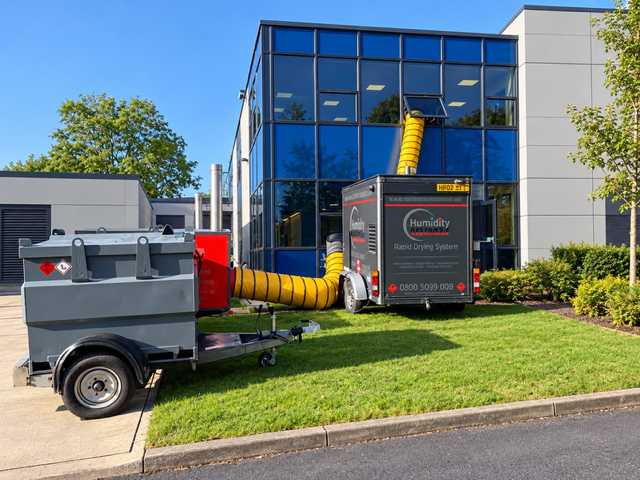
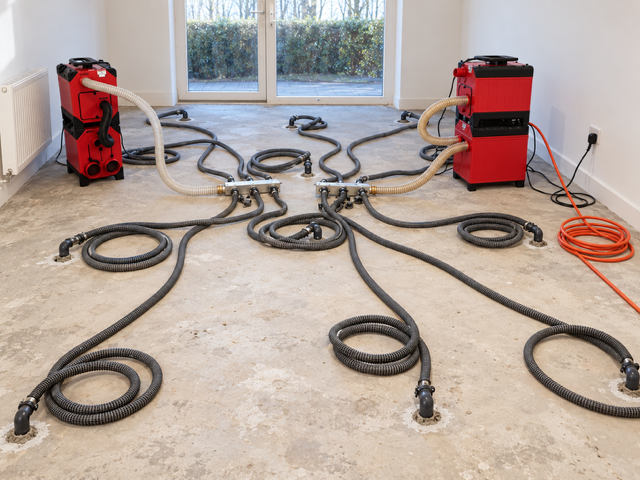
Our technicians consider the construction type, permeability of affected materials, temperature, relative humidity, vapour pressure and the route by which moisture can leave the material. Depending on the loss, a drying system may use refrigerant or desiccant dehumidification, high-volume air movement, controlled heating, or targeted positive/negative-pressure techniques for voids and layered constructions. The equipment is selected to suit the incident rather than using a one-size-fits-all package.

Where appropriate, remote environmental monitoring can supplement site visits by logging temperature, relative humidity and related conditions between inspections. This gives the technical team additional evidence of how the drying environment is performing and can help identify adverse conditions or the need for adjustment.

If floodwater may contain sewage, surface-water contamination or pollutants from the surrounding environment, restoration decisions change. Porous materials may not always be suitable for retention, and controlled removal, cleaning, disinfection, air management and waste handling may be required. The method is determined from the individual risk rather than assuming every flood is the same.

Typical applications

  • Internal flooding following burst pipes or tanks
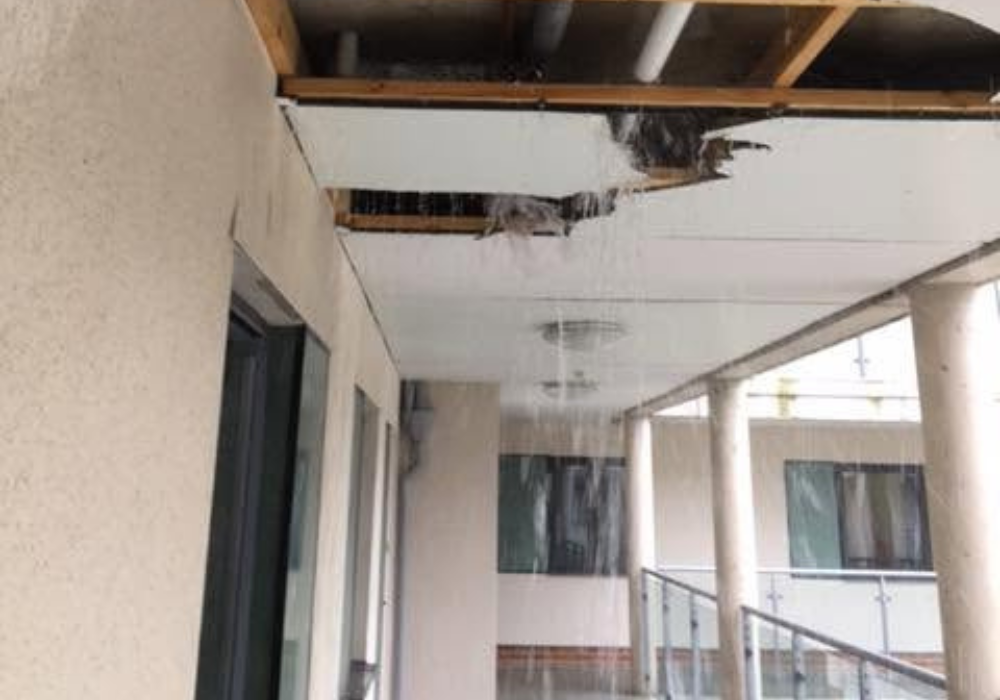
  • Storm and surface-water ingress
  • Basement and lower-ground-floor flooding
  • Flooded schools, offices, shops and communal buildings
  • Water migration across multiple rooms or storeys
  • Insurance claims requiring documented drying and damage limitation

Frequently asked questions

What should I do immediately after a flood?

If it is safe to do so, stop or isolate the source where possible and avoid contact with water if electrical or contamination risks are suspected. Contact your insurer where applicable and arrange a professional assessment so the affected area can be documented and stabilised.

Will everything need to be stripped out?

No. The extent of removal depends on the material, level and duration of wetting, contamination, access and whether the component can be dried safely and economically. Moisture mapping and construction knowledge help distinguish between materials that can be retained and those that should be removed.

How long will structural drying take?

There is no reliable fixed timescale. Drying depends on the volume of water, materials affected, construction type, temperature, humidity, access and the drying method used. We monitor progress and adjust the system rather than leaving equipment for an arbitrary number of days.

Can you help with contaminated or sewage-affected floodwater?

Yes. Where sewage or other contamination is suspected, the work is planned as a contamination event with appropriate risk assessment, PPE/RPE, controlled cleaning, selective removal and waste handling.

How do you know when the property is dry?

We compare final moisture and environmental readings with suitable reference points, material expectations and the circumstances of the loss. Visual appearance alone is not sufficient evidence that hidden moisture has been removed.

Can you work with my insurer or loss adjuster?

Yes. We regularly provide photographs, moisture records, technical reports, scopes and progress information to support insurance-related restoration and drying decisions.

Accreditations, Memberships and Professional Training

01_pqs
02_cqms
ICO_Logo_Blue
OnceForAll_-_Full_colour_RGB-scaled
05_safecontractor
06_ssip_smas_existing_website
07_builders_profile
08_citb
09_bdma_existing_website
10_iicrc_existing_website
11_pmii
Screenshot 2026-10-12 at 20.21.30
13. Dewpoint Tech Logo OCT26
14_trading_standards_checked
15_nasc_existing_website
15_nasc_scalable_alternative
16_cscs
17_bwca_small_icon