24 HOUR EMERGENCY RESPONSE: Call 0800 5999 009 or email info@humidityresponse.uk

Commercial drying designed around business continuity

Water damage in a commercial building is rarely just a drying problem. It can interrupt trading, close classrooms or offices, affect stock and equipment, restrict access, create health and safety concerns and delay other contractors. A commercial drying plan therefore needs to control moisture while also working around the operational needs of the site.

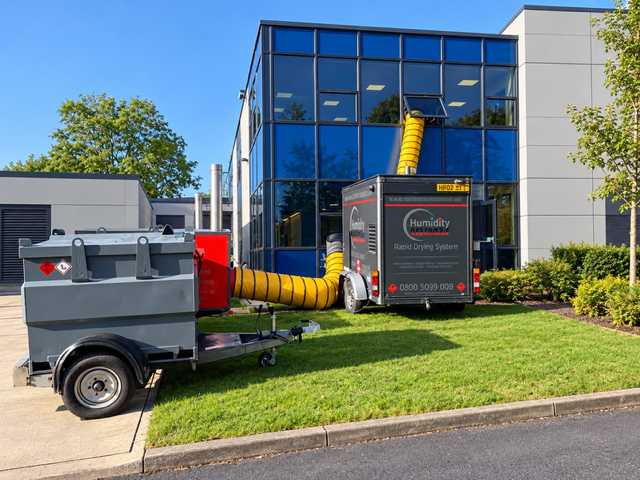
Humidity Response provides specialist drying for commercial, public-sector and multi-occupancy buildings, from localised escape-of-water incidents to large and complex losses. We combine moisture mapping, equipment planning, phased drying, environmental monitoring and technical reporting to help stakeholders understand what is affected, what can remain in place and how the drying programme is progressing.

Why choose Humidity Response

Circle

Business-continuity focused

Drying zones, access routes and equipment locations are planned to reduce avoidable disruption and support continued operation where safe and practical.

Circle

Scalable equipment deployment

Drying capacity can be configured for individual rooms, large open-plan areas, multi-storey buildings or phased projects.

Circle

Technical project management

Moisture maps, environmental data and progress reporting give facilities teams, insurers, loss adjusters and project managers a clear picture of the loss.

Circle

Remote monitoring

Suitable projects can be monitored between visits, reducing unnecessary travel while providing visibility of temperature and relative humidity trends.

Circle

Flexible working arrangements

Where the site requires it, attendance, monitoring or intrusive elements can be planned around occupancy, teaching, trading or other operational constraints.

Circle

Restoration-led approach

The objective is to retain safe, recoverable materials wherever practical and to reduce unnecessary demolition, waste and reinstatement time.

Our commercial drying process

1.

Initial loss assessment

We establish the source status, business-critical areas, hazards, affected construction and operational constraints.

2.

Moisture mapping and zoning

The building is surveyed so affected, unaffected and priority areas can be separated and the drying programme can be phased where appropriate.

3.

Drying design and logistics

Equipment type, quantity, power, drainage, airflow, heat load, noise, access and security are considered before mobilisation.

4.

Installation and stabilisation

The selected system is installed and commissioned, with containment, ducting or targeted drying added where needed.

5.

Monitoring and stakeholder reporting

Moisture and environmental readings are reviewed throughout the programme, with technical updates supplied to relevant stakeholders and the system adapted as areas reach target.

6.

Phased completion and handover

Dry areas can be released in stages where practical, followed by final verification and documented handover for reinstatement or return to use.

Technical information

Commercial losses often require more than simply scaling up a domestic drying set-up. Large volumes, high ceilings, open-plan areas, mixed construction, HVAC operation, multiple floors and continuous occupancy can all influence drying performance. The system therefore needs to be engineered around both the building and how it is being used.

Depending on conditions, drying may use high-capacity refrigerant or desiccant dehumidification, air movers, ducted dry-air distribution, controlled heating and targeted drying for floor or wall assemblies. Environmental readings are used to understand whether the air has sufficient capacity to accept moisture and whether the drying equipment is effectively removing that moisture from the building.

Power and condensate management are also important. Equipment loading must be appropriate to the available electrical supply, and water removed by dehumidifiers needs reliable drainage or pumped disposal. On larger projects, equipment security, noise, access, fire routes and the effect of heat or airflow on occupants and processes are considered as part of the plan.

Remote sensors can provide continuous environmental trend data across separate zones, helping the technical team identify changes in performance and prioritise site attendance. This is particularly valuable on long-distance, large or multi-zone projects, while final material readings remain the basis for releasing an area from drying.

Typical applications

  • Schools, colleges and public buildings
  • Offices and managed commercial property
  • Retail, hospitality and leisure premises
  • Warehouses and industrial buildings
  • Housing blocks and communal areas
  • Large or complex insurance losses
  • Business-critical escape-of-water and flood incidents

Frequently asked questions

Can a commercial building stay open while drying is taking place?

Sometimes. It depends on the location and severity of damage, electrical and contamination risks, noise, heat, access and the type of business. Where safe, we can plan zones or phases to reduce disruption.

Can you dry large open-plan spaces?

Yes. Larger areas require careful equipment sizing and air-distribution planning. We assess the volume, moisture load, construction and available power before deciding the most efficient system.

Do you provide progress reports for insurers or facilities teams?

Yes. We can provide moisture maps, photographs, environmental data, progress notes and recommendations so stakeholders can see how the drying programme is developing.

Can you monitor a commercial project remotely?

Yes, where the project is suitable. Remote sensors can provide continuous environmental trend data and alerts between visits, which is particularly useful on long-running or geographically distant sites.

Can drying be completed in phases?

Often, yes. If separate zones reach the required condition at different times, equipment can be rebalanced or areas can be released progressively, provided this does not compromise the remaining drying programme.

Do you supply equipment only?

Our specialist service is centred on assessment, system design, monitoring and verification rather than simply dropping off equipment. Equipment hire may be appropriate in some circumstances, but technical drying is most effective when the process is managed.

More Testimonials

Accreditations, Memberships and Professional Training

01_pqs
02_cqms
ICO_Logo_Blue
OnceForAll_-_Full_colour_RGB-scaled
05_safecontractor
06_ssip_smas_existing_website
07_builders_profile
08_citb
09_bdma_existing_website
10_iicrc_existing_website
11_pmii
Screenshot 2026-10-12 at 20.21.30
13. Dewpoint Tech Logo OCT26
14_trading_standards_checked
15_nasc_existing_website
15_nasc_scalable_alternative
16_cscs
17_bwca_small_icon