24 HOUR EMERGENCY RESPONSE: Call 0800 5999 009 or email info@humidityresponse.uk

Specialist leak detection using the right method for the building and the problem

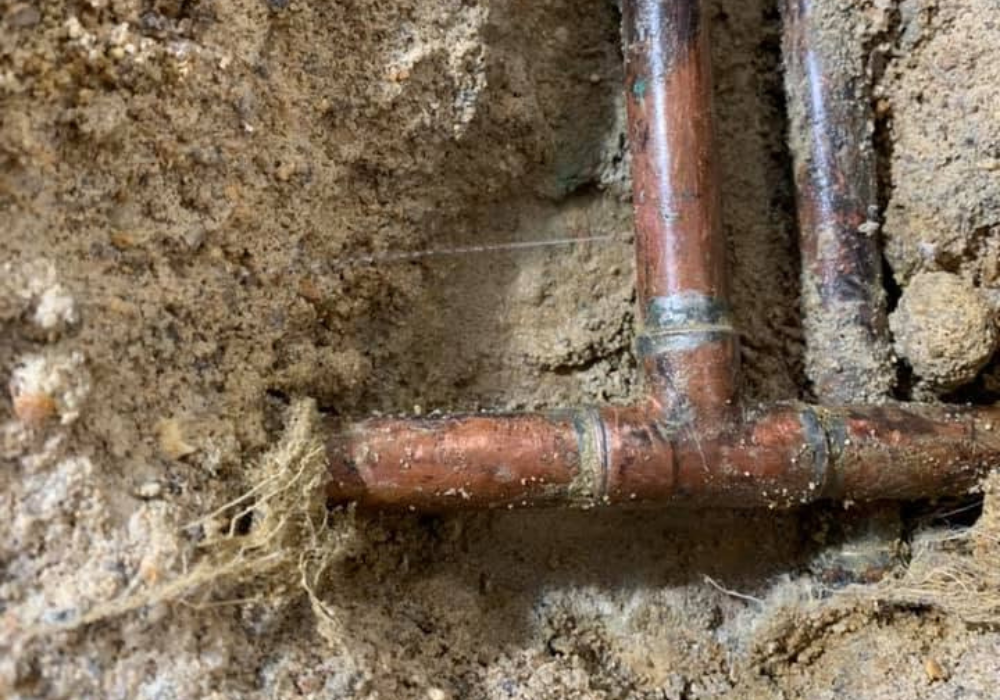
Hidden leaks can cause extensive damage before the source becomes obvious. Water may track along pipework, beneath floor finishes, through screeds, across ceilings or within cavities, meaning the point where staining appears is not necessarily where the leak began. Unnecessary exploratory opening-up can add cost and disruption without solving the problem.

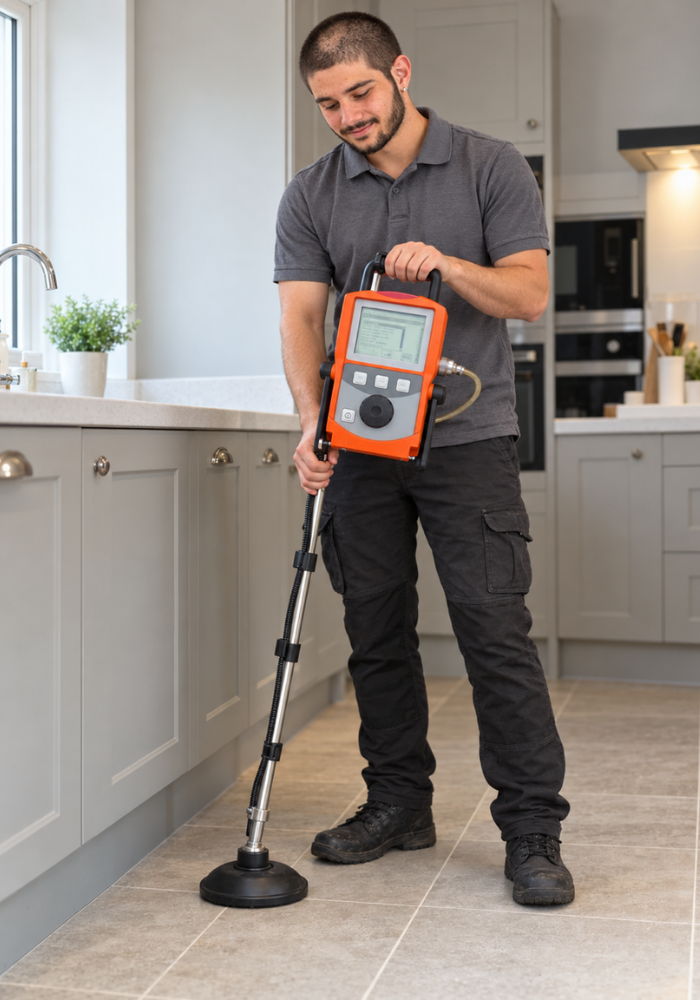
Humidity Response uses a structured leak-detection process that narrows the search before intrusive access is considered. We assess the symptoms, system history, construction and moisture pattern, then select the most appropriate combination of thermal imaging, acoustic listening, tracer gas, moisture measurement and specialist wet or dry electronic flat-roof testing. The evidence is brought together to identify or narrow the most probable source and define the next action.

Why choose Humidity Response

Circle

Multiple leak-detection technologies

We are not restricted to one method; the investigation can be adapted as the evidence develops.

Circle

Minimal-disruption approach

Non-invasive and non-destructive methods are used first where appropriate so that opening-up is targeted rather than exploratory.

Circle

Building and moisture expertise

Leak detection is combined with an understanding of water migration, construction details and moisture behaviour, helping distinguish the source from the resulting damage.

Circle

Flat-roof capability

Compatible waterproofing membranes can be investigated with specialist electronic wet-roof or dry-roof methods as part of the diagnostic service.

Circle

Insurance-ready evidence

Photographs, moisture readings, thermal images, test locations, observations and recommendations can be documented for claims, loss adjusters and property managers.

Circle

Joined-up recovery

Where water damage has occurred, the investigation can feed directly into moisture mapping, structural drying, mould assessment or other restoration services rather than ending at the point the leak is found.

Our leak-detection process

1.

Establish the history and symptoms

We review whether the problem is constant or intermittent, pressure loss, recent works, weather relationship, visible staining and previous investigations so the correct system and areas can be prioritised.

2.

Survey the building and map moisture

Visible conditions and moisture readings establish the affected pattern and help distinguish a local plumbing escape from wider ingress, condensation or migrated water.

3.

Select the diagnostic methods

Thermal imaging, acoustic listening, tracer gas, electronic roof testing or a combination are chosen according to the suspected source, construction and practical limitations, with the least disruptive suitable method generally used first.

4.

Narrow and cross-check the location

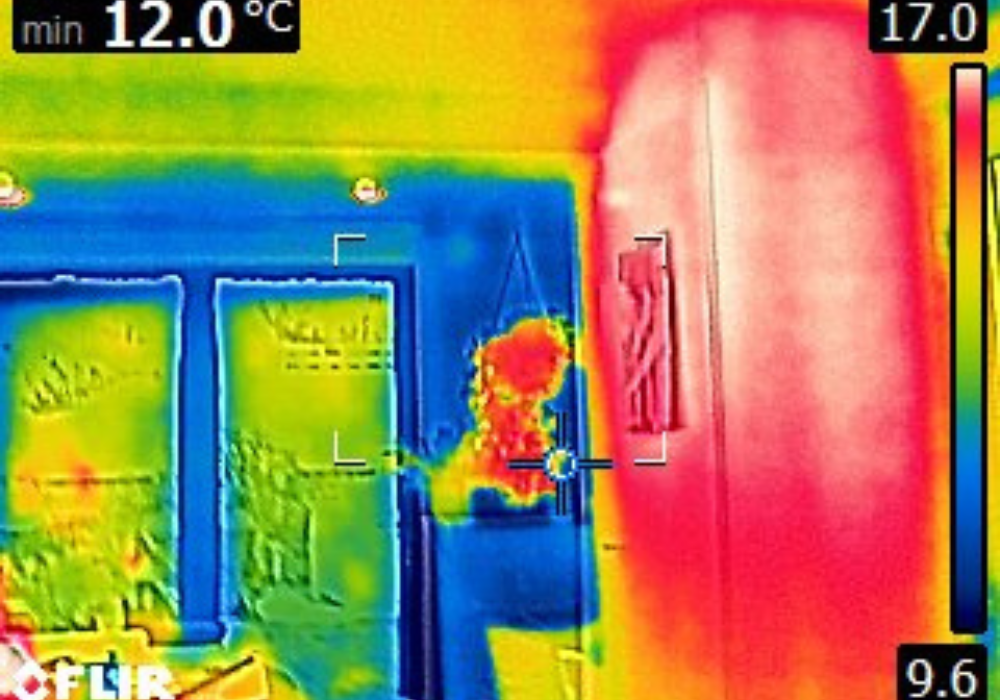
Findings are checked against other evidence where possible; for example, a thermal anomaly may be verified with moisture readings or an acoustic indication compared with pipe routes and the moisture pattern.

5.

Confirm or define the target area

The most probable position is marked and documented where the evidence is strong. If certainty remains limited, we define the narrowed area and the next test or targeted access required.

6.

Report and progress

Findings, photographs, readings and limitations are recorded. Where authorised, targeted Trace and Access can expose the source for repair, after which associated water damage can be mapped, dried and restored.

Technical Information

Thermal imaging

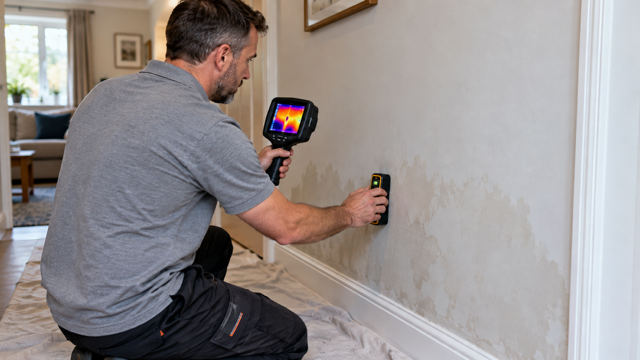
Thermal cameras identify surface-temperature differences that can reveal clues to hidden water movement, hot-water or heating-pipe routes and evaporative cooling. They allow large areas to be scanned quickly, but they do not directly see water or look through walls. Because insulation, cold bridges, air movement and other factors can create similar patterns, suspected moisture is verified with appropriate measurements or additional evidence.

Acoustic and electro-acoustic leak detection

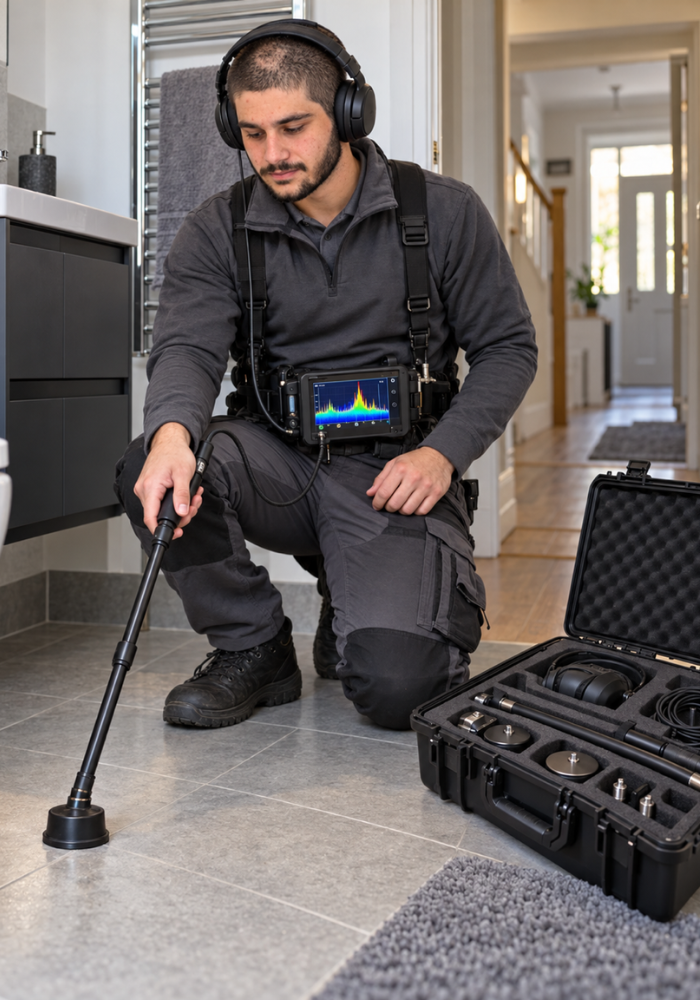
Escaping water from a pressurised pipe can create sound and vibration within the pipe and surrounding structure. Sensitive acoustic equipment and ground microphones amplify and filter these signals so the technician can compare locations and narrow the source. Pipe material, pressure, leak size, depth, construction and background noise all affect the result, so acoustic findings are interpreted alongside the wider survey.

Tracer-gas leak detection

For suitable sealed systems, tracer gas can be introduced after the system has been prepared and isolated. A commonly used mixture contains a low concentration of hydrogen in nitrogen; the small hydrogen molecules escape through very small defects and are detected with a sensitive instrument. The method is especially useful where a leak is difficult to hear acoustically or the route is concealed, although the technician must consider how gas may travel through the surrounding construction.

Electronic wet flat-roof leak detection

For compatible non-conductive membranes, wet-roof testing uses a low-voltage electrical field across a wetted roof surface. Where a breach creates a path through the membrane to earth, test probes follow the direction of current flow to pinpoint the fault. This vector-mapping method is useful over larger or complex areas, but the roof build-up, wetting and electrical return path must be suitable.

Electronic dry flat-roof leak detection

Where the roof is dry and the membrane is compatible, high-voltage electronic testing can identify pinholes, punctures, seam defects and other discontinuities in a non-conductive waterproofing layer. An electrode passes across the membrane and a defect allows a discharge to the appropriate earth, triggering the detector so the fault can be marked. Membrane conductivity, thickness, substrate and surface condition all affect suitability and test settings.

Supporting moisture measurements

Leak location and water-damage assessment are related but different questions. Once the probable source is identified, moisture measurements establish where water has migrated through floors, walls and ceilings. The mapped extent then informs drying, strip-out and repair decisions.

Typical applications

  • Hidden hot- and cold-water pipe leaks
  • Central-heating and underfloor-heating pressure loss
  • Leaks beneath floors, screeds and finished surfaces
  • Water ingress with no obvious point of entry
  • Commercial and school buildings where disruptive investigation needs to be minimised
  • Insurance Trace and Access investigations
  • Compatible flat roofs requiring wet or dry electronic membrane-integrity testing
  • Repeat or intermittent leaks where previous visual investigation has not established the source

Frequently asked questions

Which leak-detection method will you use?

It depends on the suspected source and construction. We may use thermal imaging, acoustic equipment, tracer gas, moisture measurements, electronic flat-roof testing or a combination, selecting the method after reviewing the symptoms and system.

Can you find a leak without damaging my floor or wall?

Often the search can be narrowed substantially using non-invasive methods before opening-up is considered. No technique guarantees a completely non-intrusive investigation in every building, but our objective is to reduce exploratory damage and target any access that is genuinely required.

Can thermal imaging prove exactly where the leak is?

Thermal imaging can narrow the investigation, especially around hot-water and heating systems, but it is not direct proof of water. We verify suspected findings with moisture measurements, system tests or another suitable diagnostic method where possible.

Is tracer gas safe?

Professional water-leak tracer systems commonly use a non-flammable hydrogen/nitrogen mixture designed for leak detection. The system must still be prepared correctly and the method used only where suitable for the pipework or sealed system.

Can you test flat roofs for leaks?

Yes. We have specialist equipment for electronic wet and dry flat-roof leak detection on compatible waterproofing systems. The method depends on the membrane type, roof build-up and surface conditions, which are checked before testing.

What happens once you locate the leak?

We document and mark the probable source. Where authorised, targeted Trace and Access can expose the area for repair. Plumbing, roofing or other permanent repair is completed by the appropriate trade unless specifically included in the instruction.

Accreditations, Memberships and Professional Training

01_pqs
02_cqms
ICO_Logo_Blue
OnceForAll_-_Full_colour_RGB-scaled
05_safecontractor
06_ssip_smas_existing_website
07_builders_profile
08_citb
09_bdma_existing_website
10_iicrc_existing_website
11_pmii
Screenshot 2026-10-12 at 20.21.30
13. Dewpoint Tech Logo OCT26
14_trading_standards_checked
15_nasc_existing_website
15_nasc_scalable_alternative
16_cscs
17_bwca_small_icon